i like reduction and metaphor, and that is what this is: an attempt to boil things down to their least common denominators and expose the underlying patterns and constants. if i occasionally sound like i think i've figured something out, don't worry — i mostly haven't. like so many others, i just spent enough time watching the patterns to notice a few regularities. CBT, IFS, EMDR, attachment work, exposure therapy — they all map the same landscape from different hills. what this document tries to do is name the geological structures underneath all of them, in mechanical terms, with the intent of reducing noise and increasing consensus.
What this is
this is a model — a proposed mechanical vocabulary for what mind does at all times, whether we're watching or not, grounded in physiology rather than in speculation about deeper mysteries, and applied recursively to the model-maker and the reader as much as to anyone else. not a theory, not a paradigm shift, and not the answer.
a model is a working sketch of how something operates, useful for making predictions you can check. it doesn't have to be true in the deepest sense — it has to be useful and internally consistent. this one sketches how the human mind runs in real time, in the wild, using a level of shared, constant mechanical primitives.
that's the point. every major modality i respect — CBT, IFS, EMDR, attachment work, exposure therapy — is a different spoke on the same wheel. each one connects to something real at the rim. what's usually missing is the hub — the mechanical center they all attach to. this document tries to articulate the hub.
that reduction to the least common denominators is the whole point. if i'm successful, someone trained in any of those modalities should read this and recognize their own approach embedded in the mechanical vocabulary without me having to translate. that's the test. and if i'm not successful, people will just call me stupid. so, no pressure.
what this isn't: a therapy, a diagnostic system, a replacement for any working modality, or a claim to have discovered anything nobody else has seen. the closest thing to an original thought here (which isn't) is my use of recursion. everything else is common ground with people who've been thinking about this for a lot longer than i have.
Part I — Foundations
1 Everything is a system
before we can talk about mind, we have to describe the frame it lives in. nothing about mind operates in isolation. every interaction sits in some kind of context, and every element of a system has an affect on the whole, whether it knows it or not. if we function within a system and don't account for our own space, function, and effect on it, we're fucking it up.
in an orchestra, every musician's timing, volume, and phrasing shapes what the whole thing sounds like — whether they mean it deliberately or not. sitting still with an instrument is a choice. everything has a wavelength. treating our own contribution as neutral or detached from the system is a form of playing badly.
that's the frame. mind is a system.
2 Everything is skill × resource allocation
here's the performance equation. what looks, from the outside, like competence or level of function is two things multiplied together: a skill level, and the percentage of necessary resources allocated to executing that skill at that moment.
performance = skill × % resource allocation
success is just: to what degree was the performance adequate to the task in front of us, and did we make the cut?
it looks stupid because it's simple. but the simplicity is doing a lot of work, and what keeps it from being stupid is the recursion. because allocating resources is itself a skill. perceiving a situation and estimating what resources it needs is a skill. deciding which skill to utilize is a skill. every one of those depends on other skills that depend on other skills, and every one of them costs resources to run. they cycle and spiral on each other. and skills are very, very specific, with very specific contextual parameters assigned at the perceptual level. the same physical event might call for entirely different skills two days apart, because the pattern has shifted. familiar-looking situations aren't necessarily the same problem. discernment is a skill. picking the right skill is a skill. holding still long enough to figure out what skill the moment needs is a skill. managing emotions is a skill. not hemorrhaging emotional energy — the very resource we need to execute most skills — in the meantime is a skill. tolerating discomfort long enough to act deliberately instead of reactively is a skill. every one of these has a cost. every cost gets subtracted from what's available for the next skill in the queue.
resources, however, are finite — and the ceiling behaves less like a fuel tank that drains and more like a thermal one. think of a processor under sustained load: it runs full-tilt fine for a while, but push it hard enough for long enough and it throttles — downclocks itself to a lower, safer speed to keep from frying. it didn't run out of anything; it's protecting itself. we work the same way. we don't get to run every skill at full blast all the time; there's an economy at play, and under sustained load the whole system quietly drops to a lower clock. just because we can operate at a higher level doesn't mean we can sustain it this time. and yeah, you guessed it — managing that ceiling is itself a skill.1
this is the piece the whole model rests on. the performance equation, run recursively, at every level of the system, all. the. time.
3 The RSP phenomenological model (rock, scissors, paper)
the performance equation runs on a specific pipeline. three layers, in a specific order, at very different speeds (and so, asynchronous). the order of operation matters because it determines what has time to influence what.
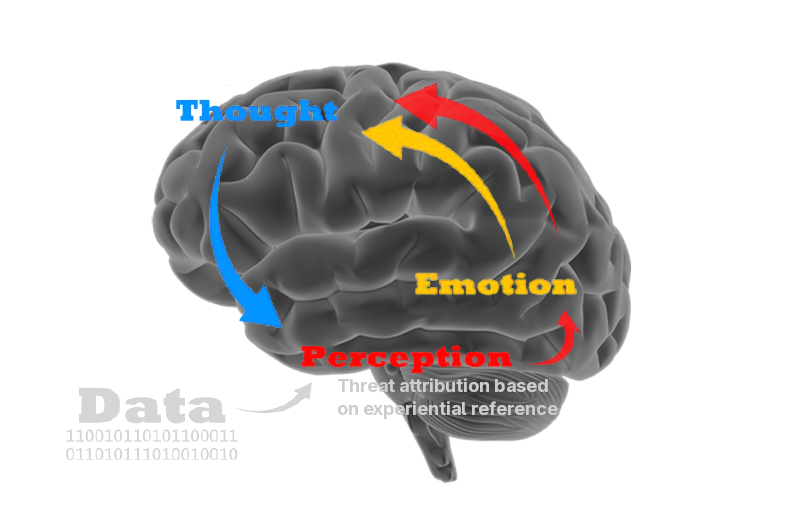
perception → emotion → thought → back to perception
which maps to rock-scissors-paper logic. each layer dominates the next by shaping its inputs, then the cycle reruns. perception (rock) dictates what emotion responds to. emotion (scissors) colors thought, so that thought rarely gets initiated without investment or assumption baked in. and thought (paper) has the — albeit comparatively slow — ability to shift perception by editing what perception preloads (i.e. expectation) on the next pass. the "back to rock" is what makes reframe possible; it's our window of opportunity to execute free will: change what thought delivers on one pass and perception's models shift for the next.
perception runs fast. we don't have a clean number, but the closest handle is monitor refresh rate — and competitive gaming is where the real-world data lives. as displays push up into the hundreds of hz, players' target-tracking and effective reaction keep measurably improving, with the gains tapering off somewhere north of 300 hz. that's not proof perception "runs at 400 fps" like a clock — a good chunk of that gain is just the screen handing you the world sooner — but it does mean the front end of the system is fast, a shitload faster than anything downstream. i'm being loose with the number on purpose; the scale is the point, not the digits.2
emotion — the central nervous system's response to what perception just delivered — runs slower. the threat signal starts firing on the order of 70–100 ms after the stimulus — still the fast, pre-conscious part of the loop; it's already moving before "you" are.3 emotion isn't mental. it's physiological. it's muscle memory — read-only in some places (evolutionary hardcode: the amygdala flags threat before the rest of the system has any opinion) and non-volatile in others (learned associations: grandpa's chair, relational betrayal, trauma). both are addressable — but we'll come back to how that works later.
thought — the conscious layer, the one we identify with — runs slower still. the perceptual sampling underneath it cycles maybe 7–13 times a second, but the actual throughput of deliberate thought is almost comically low: our conscious bandwidth has been clocked at something like ten bits per second — while the senses feeding it are pulling in on the order of a billion. thought doesn't just lag the loop; it's a narrow serial straw sipping from a firehose. it's always bringing up the rear.4
here's how it flows. the first part of perception is the passive, absorbing component: data comes in from the world. but it doesn't stay data — because the active component of perception then converts it into information by running it against pre-loaded models, values, platonic ideals, whatever. that value-assignment step is active. it's what makes an object meaningful, phenomenologically. brow, leather, four legs, high back, arm rests — those are data points. assembled into not just chairness, but grandpa's chair, the one he sat in while you sat next to him and he dropped warm, grandfatherly, yoda wisdom — that's information, meaning. so it's not just a chair; it has emotional relevance, and that's a specific preload.
the CNS responds to the information, not the data. the handing off of that information from perception to the CNS is what generates emotion. and at this level, it's mechanical. there's no room for autonomy, because we don't even know we're feeling anything yet.
thought is always late to the party. it's primed on both prior inputs: the object information from perception, and the emotional information from the CNS. by the time thought weighs in, the emotion has already fully executed and the lens is colored. the greater the emotional weight, the more colored the thoughts that follow — which we usually mistake for our perception. it isn't. it's perception filtered through emotion. so, yeah — by the time we know we're feeling it, we already dun felt it.5
that lag is why reactivity is real. it's not a character flaw. it's a refresh-rate mismatch and an order-of-operations problem.
and here's the part that matters: you can't out-react that lag. a genuine reaction — stimulus in, response out — bottoms out around a tenth of a second and won't go lower, no matter how sharp you are.6 that floor is just wiring: light hits the retina, the signal crawls up to cortex, the decision crawls back out to muscle. the only way anyone ever looks faster than that is by not reacting at all — by anticipating. loading a prediction ahead of time so the response is already staged when the moment lands. skilled performance under pressure isn't quicker reaction; it's better anticipation. the system that wins isn't the one that reacts fastest — it's the one that saw it coming. which, as it turns out, is the whole game: get ahead of the loop instead of chasing it.
curbing reactivity, initially, is more or less damage control. depending on the emotional weight and degree of distortion, we're often too late in the cycle to prevent the response, and can only try to fix what comes after. of course, skills come into play here — but the catch-up is real. cognition can't edit emotion directly. what it can do is change what perception preloads. see it differently — or notice something new about it — and the value assignment shifts. shifted assignment means different meaning. different meaning means different CNS response. different response means different thought. the loop reruns with different inputs. that's the whole move: perceptual reframe.
4 The three threats
the RSP model is the pipeline. the performance equation is the operational logistics. and the three threats are what feed the whole system its urgency and load.
any moment can register one, two, or all three of them. the level of perceived threat determines reactivity and resource allocation — and that resource subtracts from what was available for every other skill in the queue.
the three threats:
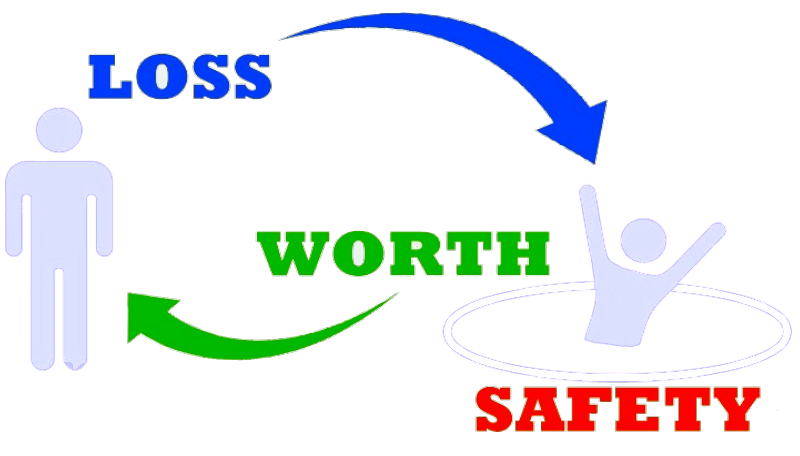
safety — the physical threat. get hit, bleed, die. the one everyone recognizes.
loss — losing something external we value. a person, a resource.
rejection — losing worth. the internal one. the sense that we're not enough — not a good enough man, husband, father, son, therapist, whatever the load-bearing self-concept happens to be.
safety is obvious. the other two need the survival logic to make sense.
one person alone in the wild is lunch. doesn't matter who we are — special forces, eagle scout, survivor champion — nobody who lives alone in the wilderness dies of old age. sprain an ankle, get a cut that goes septic, catch a cold at the wrong time. something eventually gets behind us. and when it does, we die. horribly, brutally, and alone. nature's retirement plan is the circle of life.
but ten people together with just... sharp sticks? that's a hunting party. not just a hunting party — an apex predator. hell, THE apex predator. because ten humans coordinating with sharpened sticks can reliably bring down any land animal on the planet.
so survival is contingent on membership and on the strength of the party. ten is stronger than nine. nine stronger than eight. all the way down to one, then dead. that's the hard-code under loss. losing someone we depend on, or who depends on us, ancestrally meant a real chance of ending up on nature's menu.7
exile — getting kicked out — was the fate worse than a quick death. instead of a sudden end, the exiled got the slow one: alone in the wild until something got behind them. that's the hard-code under rejection.
so we aggress for those we love, usually without hesitation or thought. and we fight to demonstrate our worth, as proof against abandonment. physical threats are textbook. loss is the "go mama bear on..." reflex — the immediate, disproportionate escalation to protect our own. the first two are... situational. but worth — worth is the constant one. what moment of what hour of what day are we not worried about being good enough? even in our dreams we often work through subtle (and not-so-subtle) themes around worth. it hums in the background of every interaction we have. on a good day. most days it screams.
now the architecture piece. threat recognition doesn't work the way most people intuit. we don't see something, register it as a threat, and react. we register everything as a threat by default, and it stays classified as one until we can determine that it isn't. or at least, to what degree it isn't.8
a snake in the kitchen we can't identify? as far as our nervous system is concerned, it's the most venomous snake on the planet. it stays that way until we can classify it otherwise.9
but it's not binary. it's a matter of degree. if we get up from bed in the dark of night, walk barefoot to the kitchen for a glass of water, and accidentally drop it on the floor — that isn't going to fire the same alarm as an angry bear on the porch. some threats are five-alarm fires. some are minor pings. the nervous system runs a continuous classification pass, and the response scales to what it can and can't rule out.
which is why relational ambiguity is so expensive. a tone we can't read, a silence we can't classify, a look we don't understand — those default to threat until they can be assigned to something else. and the more resonant the domain (safety, loss, or worth), the more aggressively that default gets defended before it gets reevaluated. every un-classifiable moment is pulling resources from every other skill in the system, whether we notice or not, as we muddle through our skills trying to manage it. that's the mechanism behind most arguments and a shit-ton of divorces.
which is the whole point of naming this here. the threats aren't a category of experience. they're the load driver on the performance equation. everything downstream — distortion, compression, collapse, colored lens — is what happens when the threat system runs hot and the resource pool struggles to keep up.
notes
1 finite mental resources: working-memory capacity limits — Miller (1956); Cowan (2001); cognitive load — Sweller (1988); acute stress throttling prefrontal control — Arnsten (2009), Nat. Rev. Neuroscience. framed as allocation/throttling, not the "ego-depletion" fuel model — which failed a 23-lab preregistered replication (Hagger et al. 2016).
2 higher refresh rate measurably improves target-tracking and reaction — Toth et al. (2026), Social Sciences & Humanities Open. much of the gain is display latency, not a literal perceptual clock; critical flicker-fusion is only ~35–60 Hz (Şahin et al. 2021).
6 simple visual reaction time floors at ~100 ms (retina→V1 alone ~70 ms); elite gamers run ~130–180 ms. genuine "sub-100 ms" scores are anticipation, not reaction.
7 belonging as a fundamental, survival-linked drive — Baumeister & Leary (1995); why exclusion hurts — MacDonald & Leary (2005); social isolation raises mortality risk ~50% — Holt-Lunstad et al. (2010), PLoS Medicine. the tidy safety / loss / rejection split is a useful heuristic, not a canonical taxonomy.
9 preferential detection of threat stimuli — Öhman, Flykt & Esteves (2001). honesty note: the "snake superiority" effect is fragile — it failed a preregistered multi-lab replication (Many Labs 5, 2020).
Part II — The laws of emotional physics (always at play)
i call these "laws" for a specific reason: they're always operating. we don't opt in or out. we don't earn immunity by understanding them. we can only change how we function inside them by changing the perceptual meaning we feed into the grinder. that's the physics metaphor — not that these are literally physical laws, but that they behave like laws in the sense that matters: they're always on, they apply to everyone, and no amount of insight makes them stop.
each of these follows from the pieces already on the table (RSP + performance equation + three threats). none of them are freestanding claims. they're consequences of the "laws of physics."
5 Conservation
nothing is wasted. every reaction, every distortion, every shift in behavior serves a function. if it looks random, we just haven't found the function yet.
this shows up in the model as follows: every emotional reaction and resource allocation goes somewhere. every threat-classification pass consumes bandwidth. every emotional response uses energy that had to come from somewhere. every reframe attempt is a thought-layer skill drawing from the same pool that runs everything else. even avoidance costs resources — it's not zero-work, it's just work spent on a different task than the one presenting.
where we see this most obviously is in situations where a response appears disproportionate to what triggered it — like there's a gap between the two. except there isn't. that's the important bit. that "gap" is filled with something. the only meaningful question is "what?" understanding this insulates us against the fallacy that the reaction is random, crazy, or broken. it's none of those. it's a solution to a problem the system has decided is more important than whatever the outside observer thinks it should be. the job is to figure out what problem it's solving. nothing is wasted. everything goes somewhere. always. that's the first law.
6 Load coefficient
the more a moment matters to us, the more distortion enters the system.
mechanically: higher perceived stakes → more resource pulled into threat-classification and threat-response → less resource available for everything else (including accurate perception, discernment, emotional regulation, and the thought-layer skills that would otherwise catch distortion in flight). distortion rises proportionally to stakes. it's not that stakes make us worse people. the reactivity around those stakes drains the pool that would have paid for the skills we're now failing to execute.
this is why, under enough load, everyone falls apart.1 it's not a moral failing. it's mechanical. the load coefficient says: at some level of stakes, the resource pool can't cover the skills the moment requires, and something has to give. like trying to support weight no bridge was ever designed to carry.
the coefficient runs recursively. even our estimate of how much a moment matters is itself a skill running against limited resources. under prior load, we can miscalibrate stakes — either overweighting or underweighting. either way, the equation still runs, with the same "laws of physics."
7 Autonomy compression
autonomy is a thought-layer skill. it's the specific capacity to choose a meaning rather than default to what perception + emotion have already primed. and because applying resistance to reactivity and initiating a reframe is a skill, it draws from the resource pool like every other skill does.
which means autonomy isn't a fixed possession. it's performant — skill × % resource allocation. we have as much autonomy as our current skill level and resource budget can pay for. under low load, we can afford deliberate response. under moderate load, we start defaulting to habitual patterns, because the resource cost of overriding them exceeds what's available. under high load, autonomy collapses entirely — thought is too slow and the system too resource-hungry to intervene before the RSP loop has already resolved.2
this reframes a lot of behavior that gets labeled as character. someone who reasons well on tuesday and can't reason at all on thursday likely didn't get worse as a person. the load moved. same system, different pressure and resources. same autonomy potential, different budget.
8 Collapse to baseline
when the system throttles all the way down to its floor, skilled execution stops. what's left is whatever that floor is — the pre-loaded, muscle-memory baseline version of whatever skills we have or lack.
this is where shit gets real. because when we're operating at baseline, we don't have the bandwidth to even put lipstick on it. no impression management, no self-conscious performance, no strategic reframe. just the raw animal brain, deep-level defaults. what someone does under total collapse is a more honest picture of their baseline programming than anything they do while resources are still available.
but don't confuse collapse to baseline with "true self" — it's just "unskilled self." the skilled versions of us are real too; they just cost resources to run. what shows up at baseline is what runs when the system's throttled to its floor and has to keep running anyway. how and where we allocate those resources under load is the map of our value system.
which is why exposure work matters so much (we'll get to this later): the only lever we have at baseline is rewriting what the muscle-memory floor consists of. thought-layer skills add capacity above the floor (capacity and realization are not identical here); exposure raises the floor itself.
9 Gravity
nobody escapes gravity. we can only change our relationship to it.
this is worth naming explicitly, because a lot of self-improvement frameworks smuggle in the idea that enough insight, or enough practice, or enough enlightenment makes you exempt. that's horse-shit from someone trying to make a buck. the dalai lama gets angry. the trauma-informed clinician has bad reactive days. the meditator with thirty years of practice still runs the RSP loop and still bumps up against their own value systems. what changes with skill is the amount of resources required, the shape of the response, and the recovery time — not the underlying operation.
the escape route people imagine — transcendence, mastery, enlightenment — isn't escape. it's an efficiency increase. if you can lower how much a given moment weighs on your stakes-assessment (because you've genuinely internalized that the outcome isn't life-and-death, or that your worth doesn't depend on it), the load coefficient runs cheaper. and the better we are at something, the more wiggle room we have before our performance fails to meet the standard. you're not defeating gravity. you're carrying less mass, with greater efficiency.
the dalai lama doesn't escape the laws. he's just really fucking good at them.
10 Recursion limits
meta-observation — watching ourselves observe, auditing our own biases, and auditing our audits — is itself a skill. it runs on the same finite resource pool as every other skill.
which means awareness has a ceiling too. we can be aware of our biases. we cannot be aware of all of them simultaneously in real time under load. the recursion has to happen somewhere, and every level of recursion costs. at some depth, we run out of available resources.
practically: understanding a distortion pattern doesn't grant immunity from it. it grants faster recognition, shorter recovery, and — hopefully — enough buy-in to allocate the resources necessary for change. the eyeball stays colored. we just learn to notice the tint faster and correct for it. under high load, even that recognition slows down or drops out entirely, because the meta-observation skill is competing with every other skill for the same shrinking budget.
there's also a compression blindness that shows up at the deepest layers. the more embedded a pattern becomes — the more it's been reinforced, the more it's been muscle-memoried into the RSP loop — the more it disappears from self-report. we can't feel the parts of the system that run below the resolution of introspection. under load, that opacity widens: the deepest patterns are the last to get noticed and the first to fire. which is exactly the wrong direction for anyone trying to catch themselves. skilled recognition of our own patterns is a real thing, but it lives at the surface. below a certain depth, we're driving a car we've forgotten how to handle.
this is why the observer is not exempt.3 not as a moral position, but as a mechanical fact. the model applies. always. that's the whole point of calling it "laws of physics," and recursive.
notes
1 high arousal/stakes narrows attention and taxes the working memory skilled execution needs — Easterbrook (1959); "choking under pressure" — Beilock & Carr (2001). the arousal–performance curve is task-dependent, not a clean universal threshold.
2 acute stress impairs prefrontal (goal-directed) control — Arnsten (2009); and shifts behavior toward habit — Schwabe & Wolf (2009). the human behavioral stress→habit effect has failed preregistered replication (2023) — the neuroscience is firmer than the behavioral demo.
the model makes specific assertions about what's actually at play when we try to change ourselves or help someone else change. those assertions rub against some of the preceding descriptors about how therapy is supposed to work.
11 Emotions are muscle memory
this claim gets its own section because it's the piece that is often under-realized.
emotions are not mental content. they are not thoughts we have. they are not decisions we make. they are physiological events — CNS responses to meaning, executed by the same kind of architecture that swings a bat or types a sentence without looking at a keyboard. muscle memory.1
muscle memory comes in two flavors: ROM (read-only memory that can't be messed with) and NVM (non-volatile memory — firmware that can be flashed). ROM is the evolutionary hardcode. we don't have to learn to flinch when something tries to jump on our face. we don't have to learn to feel dread when a shadow moves the wrong way in peripheral vision. those responses were burned into the architecture before we ever showed up. everyone has them. we can sometimes override them at the thought layer and overwrite them at the perceptual layer, but we can't uninstall them.
NVM is the learned side. grandpa's chair. the smell of the parking lot where the bad thing happened. the specific tone of voice a parent used when they were disappointed. these get written into the muscle memory through repeated pairing between a perception and a CNS response — over enough exposures, the reflex becomes "set." and it stays long after we forget when or how it was written. the more traumatic the event and the greater the perceived threat, the more deeply carved the code.2
everything that applies to muscle memory applies to reprogramming emotions. we can't think our way into new muscle memory. we can't read our way in. we can't understand our way in. we can't watch a youtube video of someone else swinging a bat and expect the muscle memory of our own swing to change. programming that firmware requires the machine to run — repeatedly, deliberately, against the pattern we're trying to write.
this is not a metaphor. this is the mechanism.
which means most of what we call "insight" — that satisfying moment when we understand something new about our own patterns — doesn't actually change the firmware. it just gives the thought layer a new label for what the CNS is going to do next time. useful for tracking, orienting, planning, and stirring up emotional investment. useless for the actual rewrite at the muscle-memory level.
the rewrite happens at a different layer, and with a different mechanism.
12 Exposure is the only rewrite mechanism
if emotion is muscle memory, then changing emotion requires whatever changes muscle memory. and there's only one thing that reliably does: exposure. deliberate, repeated, in-the-body exposure to a pattern until the CNS trains a new response to it.3
this'll probably sound grandiose, so let me say it plain: most therapy that produces durable change is practicing some form of exposure therapy.
CBT works when it gets the client into behavioral experiments where they run the new pattern against the old trigger. it doesn't work through the worksheet. it works through the doing.4
EMDR works when the client stays present in the encoded material long enough for the CNS to write a new response with the bilateral input. it doesn't work through the eye-movement mechanism (whatever that mechanism actually is) alone. it requires the perceptual meaning of the event to activate the CNS, then leverages the bilateral brain magic to experientially rewrite that meaning through a repeated process.5
IFS works when the client actually contacts and verbally dialogues with the part, not when they conceptually understand parts theory. the contact/dialogue is the exposure. the firmware learns something in that contact that reading the book can't teach.
attachment work works when the client re-experiences relational rupture and repair inside the therapy container. that's exposure to the problematic stimulus and a corrective attachment pattern.
exposure therapy works when it is what it says it is.
i'm not trying to shit on anyone's precious thing. talk therapy that stays entirely in the cognitive layer — insight-focused, narrative, purely reflective — can be genuinely useful for orientation, meaning-making, the sense of being witnessed, and opening the door for the kind of investment necessary to tolerate the ensuing exposure. but by itself it will plateau in terms of firmware change, because it isn't flashing the code. no amount of understanding the pattern rewrites the pattern. the firmware update has to run.
this doesn't mean the modalities are wrong. it means they all work through the same underlying mechanism, and naming that mechanism honestly is how we strip away noise and have a more precise, efficient dialogue.
13 Cognition's leverage is assessing and composing
if the firmware can only be rewritten by exposure, what does cognition actually do?
it edits the new program.
remember the RSP flow: perception assigns value by running incoming data against pre-loaded models, which produces the information the CNS responds to. those models — the value-assignment templates — are addressable at the thought layer. we can consciously change what we bring to the next perception, which then elicits a different emotion / CNS response.
we feel what we see.6 see sad, feel sad. see happy, feel happy. but if cognition can change what we see (or the frame through which we see it), the emotional response shifts mechanically. "well, maybe if we look at it this way..." — different frame, different value assignment, different meaning, different CNS response. that's the cognitive leverage.7
this doesn't override the emotion in flight. by the time we know we're feeling it, we already felt it. what it does is change the preloaded value for the next iteration through the circuit. insight lets us craft that value and flash the updated code into the perceptual framework. repetition, with sufficient exposure, lets the muscle memory learn the new routine as a default.
so cognition and exposure are complementary, not competing. cognition selects better values to update the code; exposure writes them into the firmware. neither alone is enough. cognition without exposure gives you a well-articulated prison. exposure without cognition gives you nightmare fuel — muscle memory that isn't attached to a coherent understanding of when and how to use it.
and tolerating the discomfort of running the new code before the mechanism has caught up — that's a skill too. a specific one, drawing from the same finite resource pool as everything else. the willingness to sit in the gap between "i can see it differently" and "my body has updated its response" is where most therapeutic work actually happens. and yes, it costs. and yes, some days we don't have the budget for it. that's the equation running, exactly as advertised. so yeah — embrace the suck.
2 emotional arousal deepens memory consolidation via the amygdala and stress hormones — McGaugh (2000); Cahill & McGaugh (1998). it deepens strength/vividness — which is not the same as accuracy.
the recursive performance model, or emotions 101, or whatever you prefer to call it, isn't a paradigm shift. all i'm doing (or attempting to do) is name a common mechanical architecture for what a lot of good practitioners already know.1 each of the modalities that inspired it sees the terrain from a different vantage. this document tries to describe the architecture itself, in language that lets those vantages be understood through a unified vernacular.
the specific hodgepodge — RSP as the phenomenological pipeline, the recursive performance math as the operating principle, the three threats as what drives load, and the laws of physics always at play — those are the only pieces i had some degree of authorship over.
the model is simply meant to be a really good metaphor. a metaphor that runs consistently under real-world load, applies to itself as strictly as to its object, and describes what most modalities are actually doing under the hood when they work. being a good metaphor is not nothing. good metaphors are how humans hold complexity steady when the shame profile of an alternative framing might keep them from engaging at all.
notes
1 "different modalities, shared mechanism" is the best-evidenced form of the common-factors / contextual model — Wampold (2015), World Psychiatry. though specific ingredients (especially exposure for anxiety/PTSD) still do real, measurable work — it isn't only common factors.